Database-supported AI tools can be divided into two categories: Finders and Connectors.
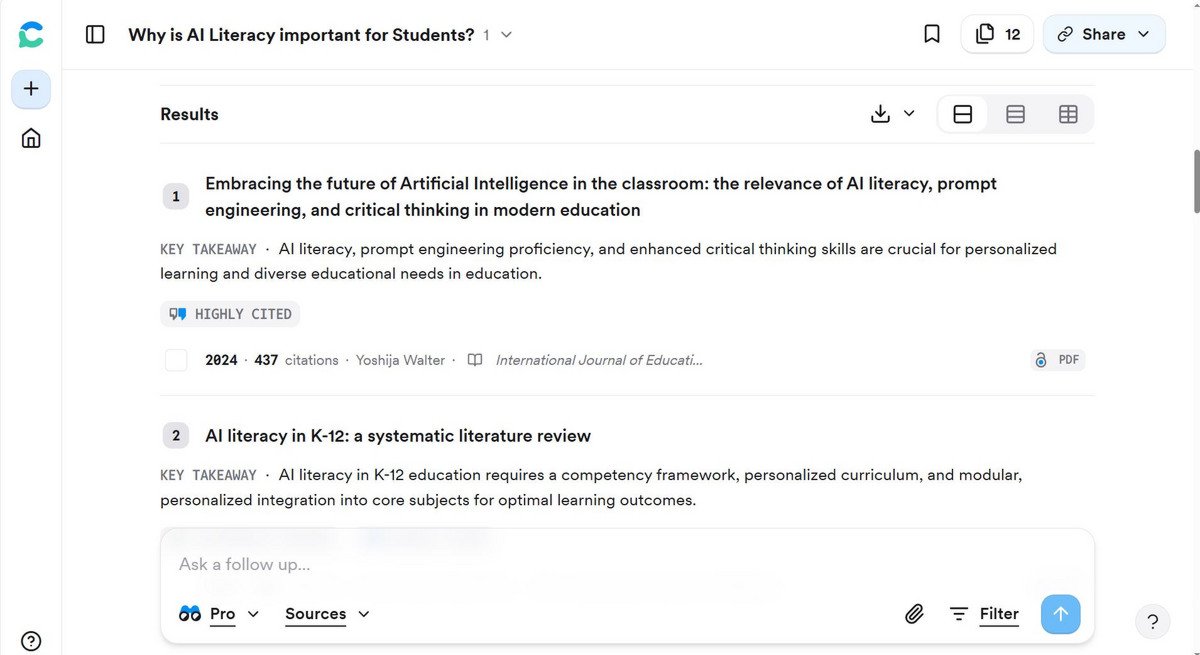
Finders identify and prioritise relevant literature based on search terms or full queries.
Finders operate similarly to digital library catalogues: users can enter keywords, phrases, or even complete questions and receive matching results.
These tools search metadata, abstracts, and in some cases full texts to identify and rank relevant publications.
They are particularly useful for STEM and medical research, as they primarily locate English-language Open Access articles with DOIs. However, they are less suited for humanities, social sciences, theology, or law.
Finders not only help you discover relevant literature even when you don’t know the exact technical terms, but they also support comparing, summarizing, and preparing content.
Automated additional features such as abstracts generation, tabular extractions, or reading aids (e.g., highlights, translations) can speed up the research process.
Compared to traditional databases like Web of Science, BASE, or Google Scholar, Finders also offer more intuitive, natural‑language queries and time‑saving summaries.
However, paywalled works or recent non‑English monographs are difficult or nearly impossible to find. The number of results is often smaller than in traditional databases -especially when dealing with paid content or literature that is less well covered in specific fields.
In addition, the usefulness of certain extra features should be viewed critically: playful elements such as the Consensus Meter (which displays how roughly 20 of the most relevant publications evaluate a yes/no question) or deep‑research functions can provide a quick initial overview, but they are usually paid, limited to open‑access articles, based on non‑transparent ranking methods, and/or produce incomplete or biased summaries. Especially for complex research questions, such automated results can lead to misinterpretations.
Examples of Finders include, among others:
AbsClust; Ai2 Paper Finder; Ai2 Scholar QA; Consensus; Elicit; Evidence Hunt; Google Scholar; Labs; Keenious; ORKGAsk; R Discovery; ScholarInbox; ScienceOS; Scinapse; SciSpace; Semantic Scholar; Undermind
Connectors reveal thematic links between papers by analysing them and grouping them into clusters.
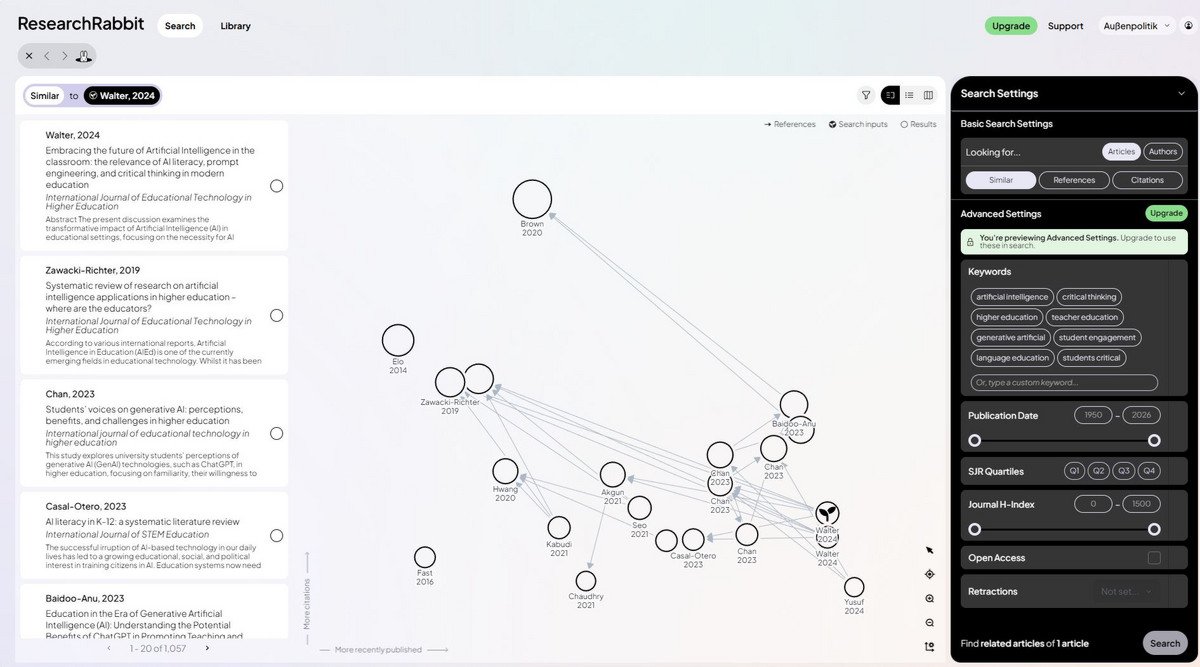
Connectors help discover thematically related literature based on a known starting paper (the “seed paper”).
This approach mirrors the snowball method of literature research.
The starting point is always a seed document, defined via DOI, title, keyword, or an uploaded PDF file. Building on this, the tool identifies publications that are directly or indirectly connected to the selected text - whether through mutual references, thematic proximity, or AI‑based similarity analyses that reveal connections not immediately visible in bibliographic data.
The results are then presented in a visual, thematically grouped cluster, making complex research areas and author networks visible at a glance. They offer an especially intuitive entry point for the humanities and social sciences.
Connectors identify bibliographically linked publications registered in databases like Crossref, OpenAlex, or Open Citations. Their particular added value lies in systematic literature review, detecting collaboration structures, and identifying works that are connected to the source text through multiple intermediary publications.
Additionally, visualizations simplify exploring new research topics and enable intuitive navigation through bibliographic networks.
Some tools (e.g., Scite, a paid service) go even further by accessing full texts and precisely highlighting how a work is cited at a specific passage (“citation statements”), enabling a more nuanced assessment of scholarly discourse.
At the same time, there are clear limitations: Their output quality depends heavily on the specific research field and the underlying data availability.
Older works without persistent identifiers, publications with sparse metadata, or print‑only literature are captured only inadequately, which reduces the informative value of the networks.
In addition, only a few filtering options are often available, meaning that bibliographic information must be checked and corrected manually because it is sometimes incomplete or incorrect. Automatic content summaries are often missing, even when abstracts are available.
Compared to established services such as Google Scholar, Connectors therefore offer no quantitative advantage, but rather an alternative, visual perspective on existing data collections.
Examples of Connectors include, among others:
Research Rabbit; Connected Papers; LitMaps; Open Knowledge Maps; Inciteful; Local Citation Network; Scite